
Autonomous Driving Vehicles – Insurance Coverage Implications – 2026 Update

Autonomous vehicles (“AVs”) will have a huge impact on the automobile insurance industry. A study done by Stevens Institute of Technology estimates that there will be 23 million autonomous vehicles on U.S. highways by 2035. However, with consumer hesitation and other hurdles, it may take decades before self-driving cars are fully adopted. As a result, there will likely be a transitional period where both self-driving vehicles and human-driven vehicles are on the road, presenting insurers with some challenges. Once autonomous vehicles are fully adopted, there will be new risks to insure, such as equipment failure, hacking and other new technology.
The U.S. Department of Transportation’s National Highway Traffic Safety Administration (NHTSA) categorized autonomous vehicles using the International Society of Automotive Engineers’ (SAE) classification of autonomous vehicles levels between Level 0 and Level 5:
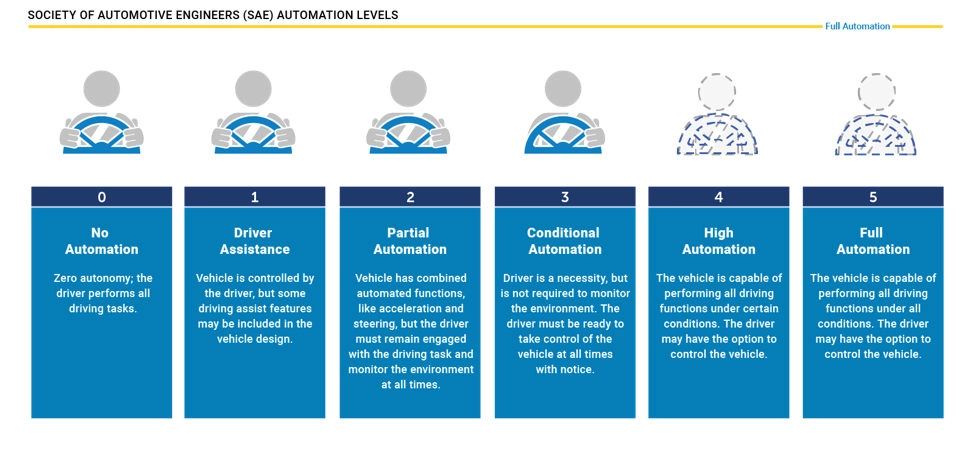
Source: NHTSA, Automated Driving Systems 2.0: A Vision for Safety.
Benefits of Automation
Considering the majority of accidents involve human error, the promise of autonomous vehicles could have a negative an impact on collision underwriting as it delivers even greater benefits to society. Some of the benefits of autonomous vehicles include increase in safety, economic and societal benefits, efficiency and convenience and mobility.
Safety – Automated vehicles’ potential to save lives and reduce injuries is rooted in one critical and tragic fact: 94 percent of serious crashes are due to human error. Automated vehicles have the potential to remove human error from the crash equation, which will help protect drivers and passengers, as well as bicyclists and pedestrians. When you consider the National Safety Council estimate of motor-vehicle deaths in the first half of 2026 to be 18,460 [1], you begin to grasp the lifesaving benefits of driver assistance technologies.
Economic and Societal Benefits – Automated vehicles could deliver additional economic and additional societal benefits. A NHTSA study shows motor vehicle crashes cost American society $340 billion in 2019, which is equivalent to approximately $1,035 for every person living in the United States, with lost workplace productivity costs totaling $75.5 billion [2]. Eliminating the vast majority of motor vehicle crashes could erase these costs.
Efficiency and Convenience – Roads filled with automated vehicles could also cooperate to smooth traffic flow and reduce traffic congestion. Americans lost an average of 63 hours sitting in traffic in 2024 [3], cutting into time at work or with family, increasing fuel costs and vehicle emission. With automated vehicles, the time and money spent commuting could be put to better use. A recent study stated that automated vehicles could free up as much as 50 minutes each day that had previously been dedicated to driving.
Mobility – Automated vehicles may also provide new mobility options to millions more Americans. In 2020, about 1 in 6 people in the United States were age 65 and over [4] and currently more than 1 in 4 U.S. adults have some type of disability [5]. In many places across the country employment or independent living rests on the ability to drive. Automated vehicles could extend that kind of freedom to millions more.
Laws and Regulations
Federal Regulations:
In January 2020, AV 4.0 was announced, which builds upon Preparing for the Future of Transportation: Automated Vehicles 3.0 (AV 3.0). AV 4.0 is structured around U.S. Government AV principles, administration efforts supporting AV technology growth and leadership, and U.S. Government activities and opportunities for collaboration. AV 4.0 looks to secure a consistent U.S. Government approach to AV technologies, and detail the authorities, research, and investments made across the U.S. Government so that the U.S. can continue to be a leader in the area of AV technology [6].
State Laws: Nevada was the first state to allow the use of autonomous vehicles in 2011. Since that time, 21 states and Washington D.C. have passed autonomous vehicle legislation. Executive Orders related to autonomous vehicles have also been issued by governors in various states. The state laws vary widely in intention and implementation.
Source: National Conference of State Legislatures.
States With Autonomous Vehicles Enacted Legislation and Executive Orders
Enacted Legislation –
- Alabama
- Arkansas
- California
- Colorado
- Connecticut
- Florida
- Georgia
- Indiana
- Iowa
- Kentucky
- Louisiana
- Michigan
- Mississippi
- Nebraska
- Nevada
- New Hampshire
- New York
- North Carolina
- North Dakota
- Oklahoma
- Oregon
- Pennsylvania
- South Carolina
- South Dakota
- Tennessee
- Texas
- Utah
- Vermont
- Virginia
Executive Order –
- Arizona
- Delaware
- Hawaii
- Idaho
- Massachusetts
- Ohio
Both –
- Illinois
- Maine
- Minnesota
- Washington
- Wisconsin
Source: National Conference of State Legislatures.
As of 2025, New Jersey has a bill pending with clarifies that owners of self-driving motor vehicles must comply with existing insurance requirements.
International: The Automated Vehicles Act 2024 gained Royal Assent on 20 May 2024, which is a landmark for the regulation and roll-out of autonomous vehicles. The AVA 2024 went through parliament without great delay, demonstrating the UK’s intention to introduce self-driving technologies [7].
Insurance Coverage Implications
The need for insurance doesn’t end with autonomous vehicles, it just changes. Policies will still need to address variables, such as equipment failure, internet connectivity interruption, or even hacking. Complex insurance and liability issues could emerge from vehicles performing according to design, yet resulting in unanticipated side-effects. Also, extensive insurance coverage litigation will very likely take place at the inception of this new technology.
Progressive states that it is still early to predict how driverless cars may impact the car insurance industry ultimately, but currently, vehicles with automation are still subject to the same state minimum car insurance requirements as other vehicles. While today safe vehicle operations is generally the responsibility of the driver, even when using automated features, this can evolve with the advancement of autonomous technology and new laws [8].
Insurance and legal communities should be involved in the initial discussions with the manufacturing communities regarding insurance and liability issues with AVs. Further, automobile manufacturers are not equipped to underwrite insurance policies and risks associated with AVs.
Liability for Damages.
The question of who is liable in an accident involving an autonomous vehicle is fundamental to the future of motor insurance industry. With the transition to autonomous vehicles, some in the insurance industry are already envisioning the need to gradually move from individual coverage to insuring car manufacturers. It seems to be the consensus at this point that when an accident occurs without the involvement of a human driver, the manufacturer will, most likely, be liable. But, from a public policy prospective, it may be too costly and time consuming to require every injured party involved in “fender bender accidents” and even very serious accident with AVs to bring a product liability action. Such actions are extremely complex and take years to litigate. Some legal and insurance professionals are even theorizing about the need for a No-Fault type litigation model with AVs.
Google, Volvo, and Mercedes-Benz have already accepted liability in cases where a vehicle’s self-driving system is at fault for a crash. Tesla is taking things a step further by extending an insurance program to purchasers of Tesla vehicles. However, if car manufacturers face increased operating costs as a result of liability concerns, they may decide to make up for that by driving up the price of the vehicles. So while autonomous vehicle owners could save money on their insurance policies, the cost may end up trickling down to the price on their new car. Furthermore, is it likely that once the prices of autonomous vehicles decrease there will be greater individual ownership, and thus the need for more individual coverage.
In determining liability, AVs present new questions and opportunities with respect to data collection and management. Timely data sharing by auto manufacturers and other AV data collectors with insurance companies will be necessary to facilitate proper insurance coverage. Data could be used to establish the following: Liability in the event of an accident; accurate underwriting and pricing of insurance policies, and risk mitigation and control measures. Insurance companies will have to take a proactive approach to ensure timely data sharing and develop consumer perceptions on safety, liability, and coverage for AVs.
Premiums
Some experts predict that the frequency and severity of accidents will decline as autonomous vehicles become more prevalent. If the potential for accidents will be reduced, this should lead to lower overall premiums due to a lower risk of accidents. Many insurers already offer premium discounts for the safety features already provided by advanced driver assistance system. Thus, from a theoretical and logical standpoint at least, as the effects of increased safety become apparent, insurers may need to lower premiums to remain competitive.
For a period of time many insureds may drive a variety of vehicles, including Level 0 vehicles fully controlled by the driver, and will need traditional permissive-driver liability protection. So the real question is, what happens during the intervening period when human drivers and partial and fully autonomous vehicles share the road?
An implication on insurance is the possible, some say likely, decline in automobile ownership. Some experts believe that once autonomous vehicles are on the roads, they won’t be owned by individuals. Instead, technology companies such as Apple and Google, or ride-sharing services such as Uber and Lyft, will own them. Individuals will essentially use a “pay as you go” system, and use AVs as a taxi service or as an “Amtrak on wheels” ride sharing service. Insurance companies may have to shift their services from private vehicle owners to self-driving cars used commercially. However, once prices of AVs decrease there may be greater individual ownership.
The Future of Insurance and Insurance Coverage for Avs
There are numerous insurance issues that will need to be addressed before self-driving cars take the road, such as accidents involving self-driving cars, liability for damages, fault attribution to the human “copilot” versus the car’s manufacturer, whether an individual can nap, read a book, or text message while the car is navigating, and whether the human “copilot” will even need a driver’s license. Having the technology to make such vehicles is half the challenge, with the other half being the creation of a legal, liability and regulatory framework to govern their use on public streets [9].
Some insurance carriers, such as Travelers, for example believe that when it comes to insuring Avs, leveraging the existing commercial and personal automobile insurance structure is the best method for compensating crash victims quickly and efficiently, both now and in the future. Current insurance structure can already adapt to evolving risk environments and acts to minimize regulatory uncertainty, market disruptions, and consumer confusion. Vehicle owners of Avs should be required to purchase and maintain adequate insurance, regardless of whether the vehicle is a personal vehicle, a ride-share, or company-owned, and coverage limits should account for more expensive technology in Avs by being high enough to account for same. The insurance industry should have a central role in policymaking and stakeholder discussions with respect to Avs, and lawmakers and regulators at the federal, state and local level must coordinate to realize a consistent regulatory framework [10].
[1] NSC, Deaths decreased even as mileage increased in the first half of 2026 2026
[2] NHTSA, NHTSA: Traffic Crashes Cost America $340 Billion in 2019 January 10, 2023; NHTSA, The Economic and Societal Impact of Motor Vehicle Crashes, 2019 (Revised) February 2023
[3] Texas A&M Transportation Institute, Traffic Hits Record High as Commuters Rewrite the Rush Hour October 24, 2025
[4] United States Census Bureau, U.S. Older Population Grew From 2010 to 2020 at Fastest Rate Since 1880 to 1890 May 25, 2023
[5] CDC, Disability Impacts All of Us Infographic May 5, 2026
[6] NHTSA, Ensuring American Leadership in Automated Vehicle Technologies: Automated Vehicles 4.0 January 8, 2020
[7] LexisNexis, Automated Vehicles Act 2024: overview of key changes, enforcement framework and secondary legislation timetable (England, Wales and Scotland) May 30, 2024
[8] Progressive, Insurance for self-driving cars June 24, 2025
[9] NAIC, Autonomous Vehicles December 17, 2024
[10] NAIC, Insuring Autonomy: How Auto Insurance Can Adapt to Changing Risks of Autonomous Vehicles Dec. 18, 2019
Have Questions? Speak to an Experienced New Jersey and Pennsylvania Insurance Defense Attorney Today
Do you have questions about your case involving autonomous vehicles? Contact the insurance defense lawyers at Thomas Paschos & Associates P.C. by filling out the online contact form or calling (856)-354-6040. Our attorneys have the knowledge and experience representing insurance companies and their insured. Our New Jersey office is conveniently located at 30 North Haddon Avenue, Suite 200, Haddonfield, NJ 08033 and our Pennsylvania office is located at 303 Chestnut Street, Philadelphia, PA 19106.
The articles on this blog are for informative purposes only and are no substitute for legal advice or an attorney-client relationship. If you are seeking legal advice, please contact our law firm directly.
